



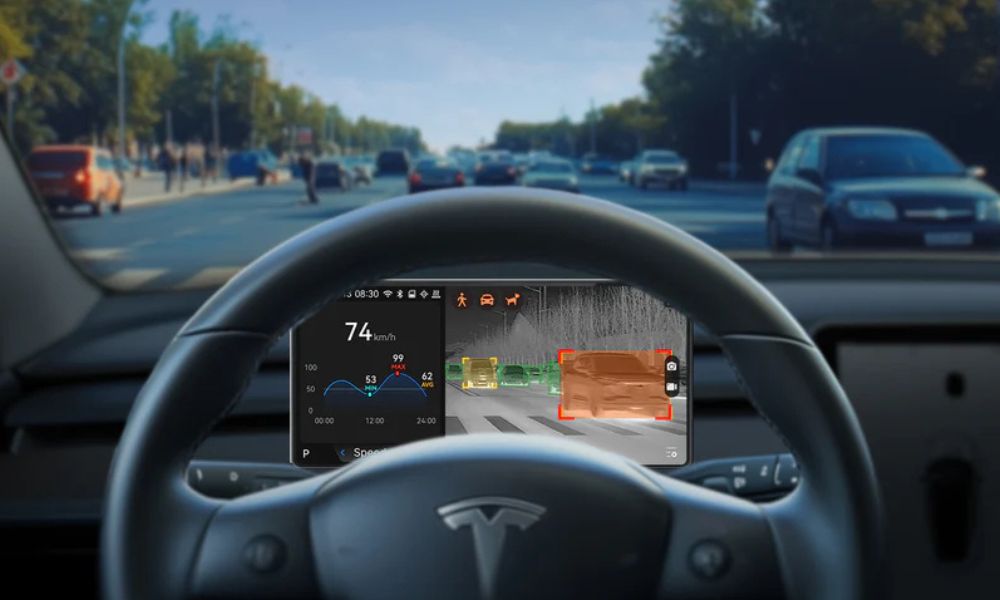
Today, automotive thermal imaging technology has become an essential safety upgrade, enabling drivers to "see" the road ahead by detecting infrared thermal signals before high beams illuminate targets, even in dense fog, heavy rain, and complete darkness.
Thermal Master offers three top-of-the-line products, focusing on their AI-driven collision recognition and detection range. Whether you need the NV500's ultra-long detection range of 500 meters, the compact NV300, or the NV300 MAX with its integrated 4K-OBD ecosystem, these are ideal night vision solutions for modern roads.
How Vehicle-Mounted Thermal Cameras Work?
The core of vehicle-mounted thermal imaging is the infrared thermal sensor. It doesn't rely on light; instead, it directly captures the long-wave infrared radiation (heat) emitted by objects. Because of the temperature differences between pedestrians and animals and the cold road, the system can accurately outline the contours of objects ahead, even in complete darkness, dense fog, or direct sunlight.
Once the thermal imaging camera for cars captures the thermal signal, the system performs millisecond-level analysis using built-in AI algorithms. It can automatically identify and distinguish pedestrians, cyclists, and wild animals, marking them in real time on the central control screen. Once a potential collision risk is detected, the system immediately issues visual and audible warnings, giving the driver crucial reaction time.
The Top 3 Best Vehicle-Mounted Thermal Cameras
Vehicle-mounted thermal cameras extend visibility beyond headlights, helping reduce nighttime collisions with pedestrians, wildlife, and road hazards. Thermal Master offers three systems built for reliable long-range detection and smart collision alerts in low visibility.
Thermal Master NV500
The Thermal Master NV500 delivers extended vehicle-mounted thermal detection up to 500m (546 yards), offering significantly longer forward visibility than standard 300m systems. With a high-sensitivity thermal sensor and AI-powered collision recognition, it quickly identifies pedestrians, animals, and vehicles, issuing fast visual and audio alerts for safer high-speed and highway driving. Triple-vision modes (visible, thermal, and fusion) help adapt to changing light and weather conditions.
Built for demanding environments, the NV500 features IP69K protection, operates from -20°C to 80°C, and supports adjustable warning sensitivity with dual alert modes. Its 6.4″ 2340×1080 OLED display, shutterless imaging, and integrated 3-in-1 system (thermal + dashcam + vehicle data) enhance real-time awareness and driving confidence when maximum range matters most.
Thermal Master NV300
The Thermal Master NV300 is built around a 256×192 thermal sensor enhanced to 512*384 by super IR resolution, giving you clear and stable thermal imaging up to 300m (328 yards). With a smooth 25Hz frame rate and ultra-fast 0.1s AI collision response, it quickly detects pedestrians, vehicles, and animals in front of your car — even before your headlights can reveal them.
Designed for real-world driving, the NV300 operates reliably in temperatures from -20°C to 80°C and features IP69K protection for tough environments. It’s a practical and dependable solution for everyday night driving and rural road safety.
Thermal Master NV300 Max
The Thermal MasterNV300 MAX takes imaging a step further with a 256×192 @12μm high-sensitivity sensor upgraded to 512×384 Super IR resolution, delivering sharper contrast and clearer detail at distances up to 300m (328 yards). It also combines infrared and visible-light imaging for enhanced situational awareness, along with fast 0.1s AI-powered collision alerts.
With its large 6.4″ 2340×1080 OLED display, shutterless zero-freeze imaging, and integrated 3-in-1 system (thermal camera + dashcam + OBD), the NV300 MAX is built for drivers who want more clarity, more integration, and a more advanced night-driving experience.

What are the Key Factors to Consider Before Buying?
- Range: It's all about how much time you have to react. If you're on the highway, the NV500 (526-yard range) gives you about 10 extra seconds to see a deer. For city driving, the NV300 (328-yard range) is plenty.
- AI Alerts: A blurry heat map isn't enough. You want a "smart" camera like the NV300 MAX that uses AI to automatically box people or animals on the screen and beep to warn you before you even see them.
- Integration: Don't clutter your car with wires. Look for a model that combines thermal views with a 4K dashcam or car data (OBD). The NV300 MAX does this best, keeping your interior neat and professional.
- Set up: Avoid expensive professional installs. Go for a "5-minute DIY" model that uses magnetic mounts and plugs into your cigarette lighter. This makes it easy to set up or move to another car.
- Durability: Since the camera sits outside, it needs an IP69K rating to survive storms and car washes. If you live in a cold area, automatic defrosting is essential so the lens doesn't freeze up when you need it most.
How to Install and Use Your Thermal Camera?
- Camera Installation: Use a magnetic mount to secure the camera to the roof or a bracket to the front grille. To ensure accuracy for AI-powered collision recognition, ensure the lens is level with the horizon and unobstructed by any vehicle trim.
- Monitor Position Adjustment: Use a suction cup mount to install the 6.4-inch OLED screen on the dashboard or near the A-pillar. Position it directly below the driver's line of sight so you can view visual alerts without taking your eyes off the road.
- Power and Wiring: Introduce the integrated cable through the door seals or firewall rubber gaskets into the cabin. You can connect it to a 12V cigarette lighter power source or use the OBD II port to overlay real-time vehicle data (such as speed and RPM) onto the thermal image.
- System Settings: Switch between thermal imaging, visible light, or fusion modes depending on weather conditions. Set the AI warning sensitivity to "High" to detect wildlife early on rural roads; set it to "Low" to reduce repeated alerts in congested urban areas.
- Maintenance: While the IP69K-rated housing and automatic defrost function can withstand various harsh weather conditions, the lens still needs to be wiped regularly with a microfiber cloth to remove dirt or road salt. A clean lens ensures the sensor maintains its maximum detection range of 500 meters during critical moments.

Tips for Maximizing Performance
Here are a few practical tips to help you get the most accurate detection and reliable performance from your vehicle-mounted thermal camera.
- Ensure Proper Installation: Mount and align the camera securely to prevent vibration and maintain accurate imaging.
- Keep the Lens Clean: Regularly clean the lens, especially after driving in dust, rain, or snow.
- Adjust Warning Sensitivity: Set alert levels based on driving speed and road conditions.
- Choose the Right Vision Mode: Switch between thermal, visible, or fusion modes depending on lighting and weather.
- Maintain Stable Power Supply: Ensure consistent power connection for reliable system performance.
Summary
Thermal imaging technology redefines automotive safety, providing a "sixth sense" beyond traditional headlights. It allows drivers to identify heat sources in dense fog, heavy rain, or extremely low light, giving them ample reaction time.
You can choose the appropriate model based on your driving environment: the NV500 is the top choice for high-speed driving requiring extreme visibility of 500 meters; the NV300 offers compact and reliable basic protection; while the NV300 MAX, with its 4K image quality and deep OBD integration, defines an all-around driving experience. Regardless of the model, it ensures you always have a clear view of the road ahead, even in challenging conditions.
FAQs
Can it really see up to 500 meters?
Yes. The NV500 identifies living objects (pedestrians and wildlife) at up to 500m, tripling the reach of standard high beams. This gives you over 10 seconds of extra reaction time during high-speed highway driving.
Will the installation void my vehicle's warranty?
No. The system uses a non-invasive DIY setup. The camera secures via magnetic mounts or brackets, and power comes from the cigarette lighter or OBD II port. No wire-cutting is required, keeping your factory warranty fully intact.
Will the AI alerts be distracting in city traffic?
You can adjust the AI Sensitivity to match your environment. Set it to "Low" in urban areas to filter out heat signatures from buildings or parked cars, and "High" on rural roads to ensure early detection of wildlife.
Related Reading:
What Makes the NV300 Max So Powerful?
What’s the Difference between Thermal Imaging and Night Vision?

Leave a comment
All comments are moderated before being published.
This site is protected by hCaptcha and the hCaptcha Privacy Policy and Terms of Service apply.