



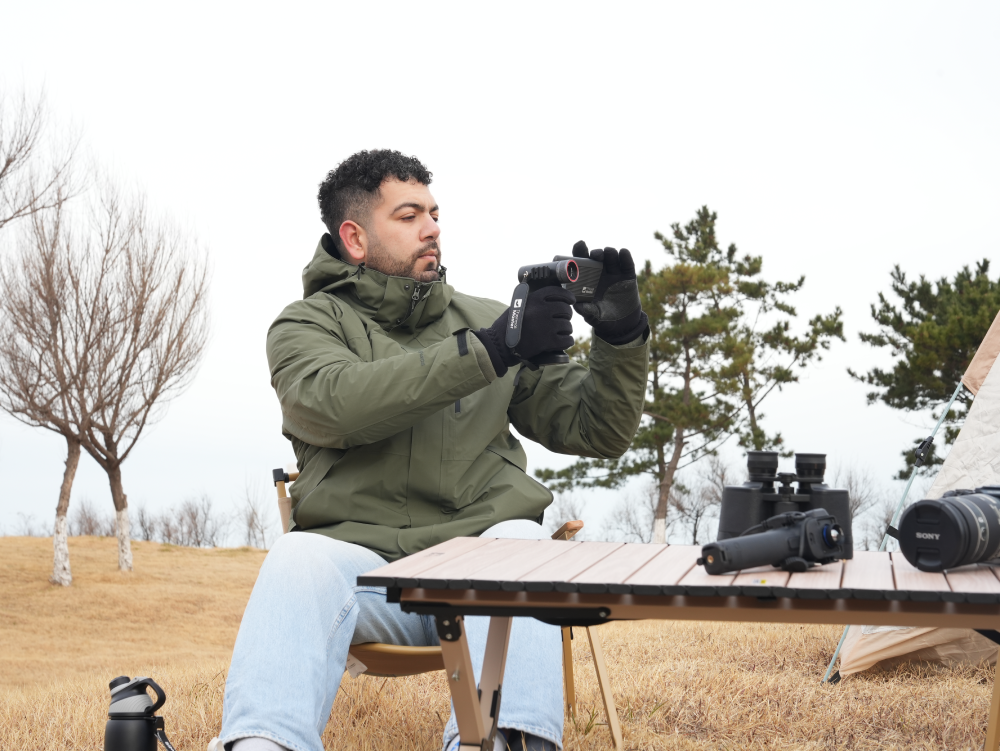
Thermal cameras for bird watching at night offer another way to locate birds when traditional optical equipment becomes less effective in dark or complex environments.
You spot a bird near the trees, look down to adjust your binoculars, and it disappears into the darkness. When you look back, finding it again among leaves, branches, and shadows can be surprisingly difficult. For birdwatchers, locating a bird can sometimes be harder than seeing its details.
Thermal Imaging Offers Another Way to Find Birds
When a bird moves into trees, darker areas, or places with limited visibility, thermal imaging can help birdwatchers locate it by showing differences in heat rather than relying only on color and shape. For birdwatchers using thermal cameras for bird watching at night, this provides another way to search when visual details are difficult to see.

This can be especially useful at night, when natural light is limited and traditional optics may not provide enough visual information to quickly locate a moving bird.
However, thermal imaging is better suited to answering “Where is the bird?” then “What bird is it?” Once the target is located, binoculars or a spotting scope are still better for examining feathers, colors, and other details.
In simple terms, use thermal imaging to find the bird, then use optics to see it clearly.
Night Birdwatching Takes More Than Image Clarity
Find Distant Birds in Open Areas
When birdwatching around lakes, wetlands, or forest edges, distant birds can become very small targets. You may spot one land near the opposite shoreline, look away for a few seconds, and then struggle to determine exactly where it went.

At night, this becomes even more difficult because the surrounding environment provides fewer visual clues. Trees, grass, open water, and dark backgrounds can all make it harder to pick out a bird with conventional optics alone. This is where thermal cameras for bird watching at night can provide an alternative way to search the area.

A longer observation range can make this search easier. DV2 uses a 2× larger lens, making it better suited for scanning distant trees, shorelines, and open areas. You can first search a wider area for the target, then switch to binoculars to examine the details.
A Larger View for Longer Observation
When you spend hours outdoors, the viewing experience matters too. A small screen can make it harder to scan an area continuously, especially when you are waiting for a bird to appear or trying to follow its movement.

DV2 features a 5-inch HD display, giving you a larger viewing area while searching through woods, along shorelines, or across open spaces. For thermal cameras for bird watching at night, a larger display can also make it easier to keep an eye on the surrounding area.
This can make long observation sessions more comfortable, particularly when the goal is not simply to capture a single image but to keep track of where birds are moving.
Keep Up When a Bird Takes Off
Finding a bird is only part of the challenge. Keeping track of it after it starts moving can be just as difficult.
John, an avid birdwatcher from Minnesota, USA, often searches for birds around forests and lakes. During one observation, he had just spotted a bird sitting on a branch when it suddenly took off, flew through several trees, and landed farther away.

For anyone using thermal cameras for bird watching at night, keeping up with a moving target is just as important as locating it in the first place.
Conclusion
If you want to find birds in difficult conditions without replacing your binoculars, choose a thermal camera that is easy to scan and quick enough to follow movement.
For those looking for thermal cameras for bird watching at night, DV2 helps locate birds in low-visibility environments with its thermal imaging, large display, and fast refresh rate.

Hinterlasse einen Kommentar
Alle Kommentare werden vor der Veröffentlichung geprüft.
Diese Website ist durch hCaptcha geschützt und es gelten die allgemeinen Geschäftsbedingungen und Datenschutzbestimmungen von hCaptcha.